
You Belong Here!
Like a zebra's markings, your way of sensing and operating is unique. If you feel you don’t fit in, you’re not broken, you’re different. And different can be powerful.Whether you’re navigating life, work, or self-discovery, I’m here to help you embrace your neurodiversity and thrive.
Do you ever feel like you’re trying to fit into a world that wasn’t designed for you? Like no matter how hard you try, you’re always just a little out of step? I’ve been there. For years, I masked my neurodiversity, trying to meet neurotypical expectations, only to feel exhausted, misunderstood, and out of place. But here’s the truth: your neurodiversity isn’t a flaw, it your unique way of being and you can turn that into a strength. Together, we can uncover your unique gifts, heal from past trauma, and create a life that works for you.
About me
I’ve been where you are. I know what it’s like to feel unseen, misunderstood, and out of place.
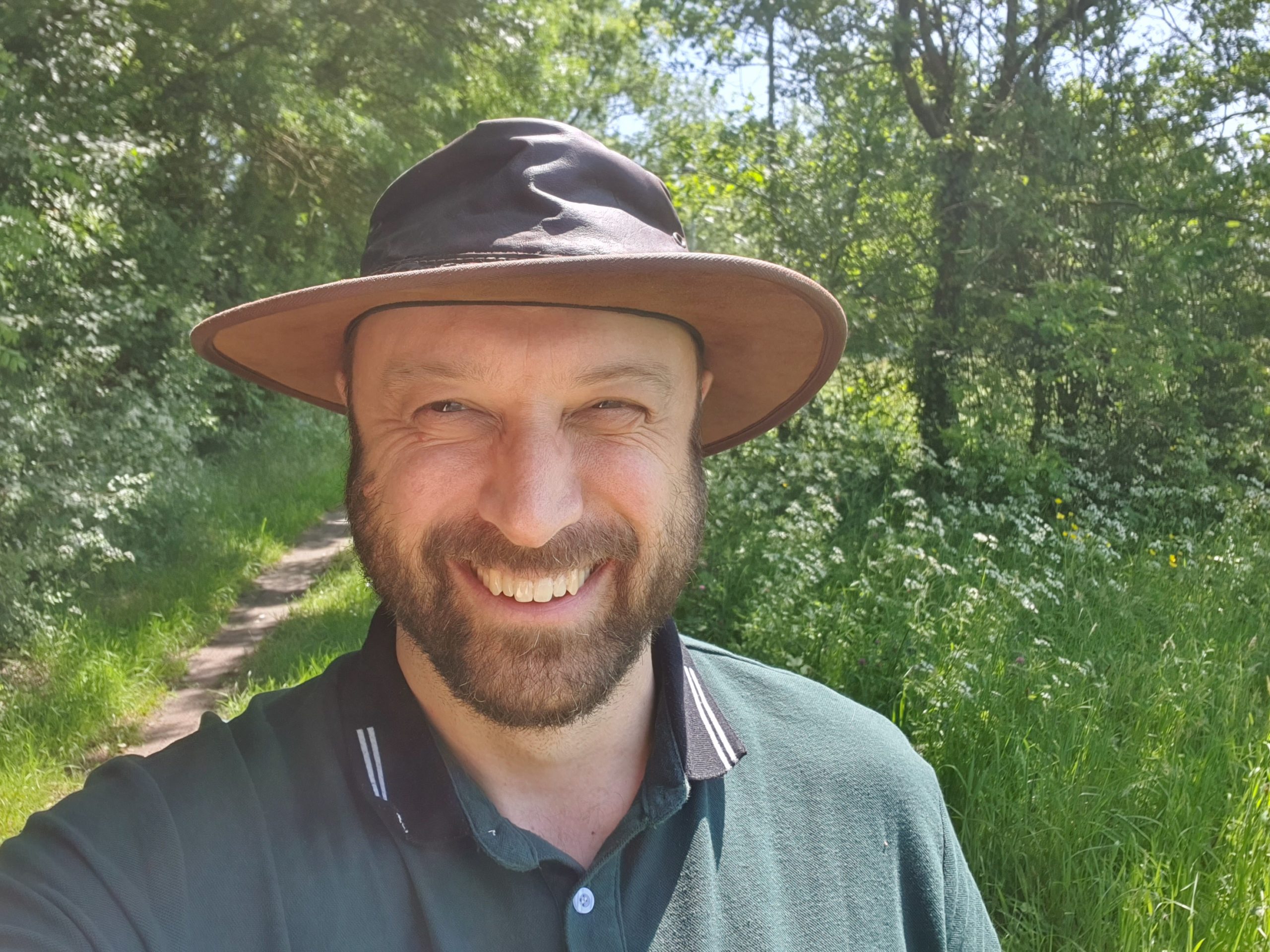
For most of my life, I didn’t understand why I felt so different. I was misdiagnosed, medicated for conditions I didn’t have, and told I needed to ‘fix’ myself to fit into a neurotypical world. It wasn’t until I discovered my neurodiversity—my combination of ADD, autism, and dyslexia—that everything started to make sense. I realized that my ‘differences’ were actually my greatest strengths: my ability to see patterns others miss, solve complex problems, and navigate change with creativity and resilience.
Today, I’m a therapist, coach, and advocate for neurodiverse individuals. I’ve spent years helping people like you discover who they are, heal from past trauma, and thrive in a world that doesn’t always understand them. My approach is rooted in person-centered therapy, Acceptance and Commitment Therapy (ACT), the systemic approach from the Palo Alto school, and Compassionate Inquiry. I also use tools like the Clifton Strengths Assessment to help you identify and leverage your unique gifts.
But my journey doesn’t stop there. I’m also on a personal path to manage my neurodiversity through lifestyle changes, especially food. I’ve learned how deeply our gut health influences our brain and nervous system, and I’ve made significant changes to reduce inflammation and support my well-being. It’s a long journey, but one that’s already brought me greater calm and clarity. I bring this holistic perspective into my work, helping you find strategies that work for your mind, body, and life.
How I Can Help You
Whether you’re navigating life, work, or self-discovery, I’m here to help you uncover your unique strengths and create a life that works for you. My approach is tailored to your needs, combining therapy, coaching, and practical tools to help you thrive.

1:1 Therapy for Neurodiverse Adults
Discover who you are, heal from past trauma, and learn to thrive in a world that doesn’t always understand you. Together, we’ll explore your unique strengths, challenges, and needs, using approaches like ACT, Compassionate Inquiry, and the systemic approach.
Self-Discovery Sessions
Explore your unique strengths, passions, and needs in a supportive, neurodiverse-affirming space. Using tools like the Clifton Strengths Assessment, we’ll uncover what makes you uniquely you—and how to leverage those strengths in your daily life.
Trauma-Informed Support
Healing the wounds of being misunderstood, marginalized, or traumatized in a neurotypical world. Using Compassionate Inquiry and other trauma-informed approaches, we’ll work together to process past experiences and build resilience.
Corporate Coaching and Change Management
Helping organizations and individuals navigate neurodiversity in the workplace. From leadership development to creating inclusive cultures, I bring a deep understanding of both neurodiverse and neurotypical perspectives to drive meaningful change.
Neurodiversity Self-Assessment
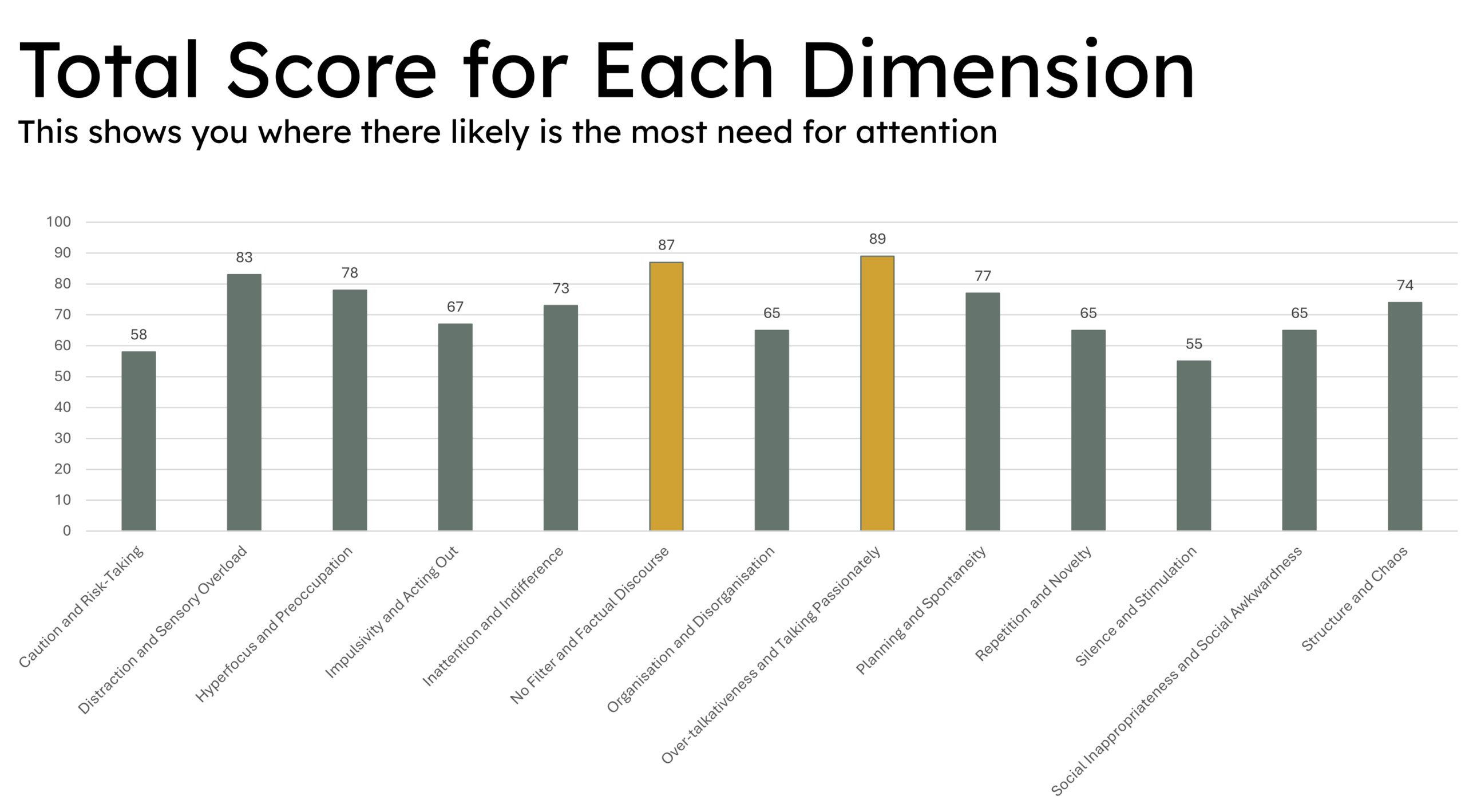
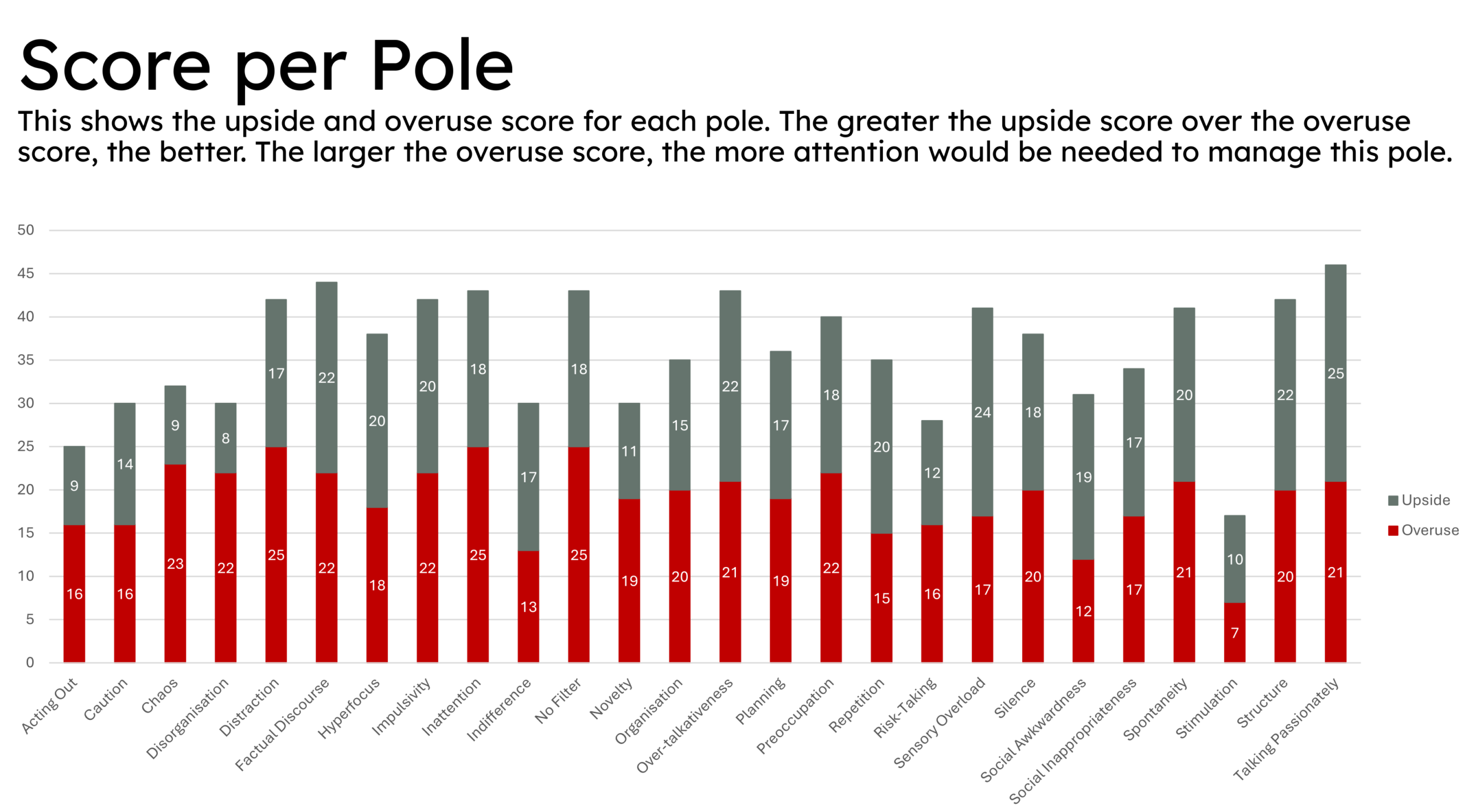
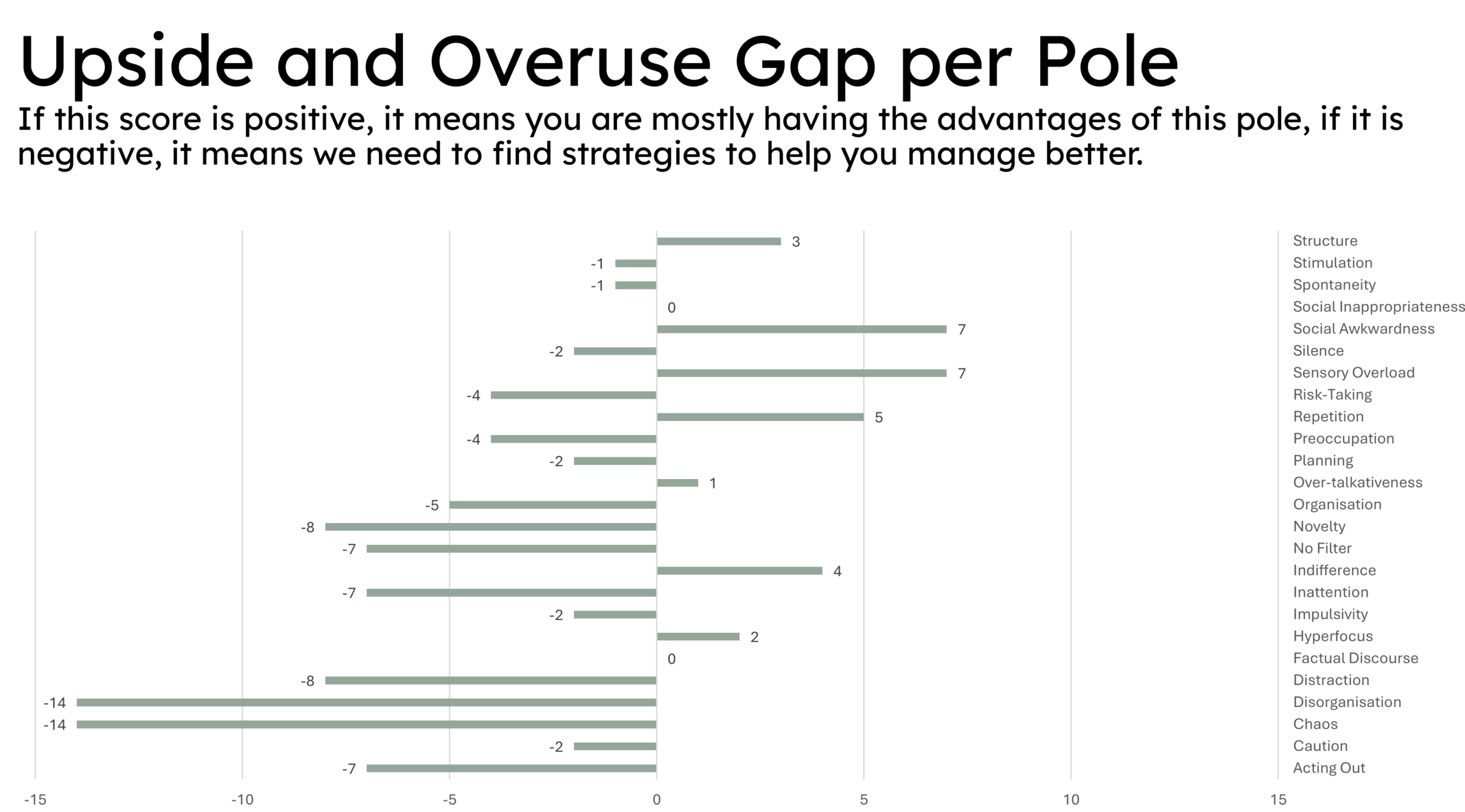
Examples of report screenshots
The neurodiversity self-assessment and free accompanying online course provide a structured way to explore and make sense of your own experience of neurodiversity.
They are not diagnostic tools, nor do they offer definitive answers, but rather a framework for reflection.
Through the assessment, you begin to identify the key tensions, or “polarities”, that show up in your daily life, such as rest and activity, structure and spontaneity, or logic and intuition.
The course then introduces the concept of polarity thinking and invites you to observe, map, and reflect on these dynamics using tools such as ClarityMaps™.
The aim is not to fix or resolve these tensions, but to better understand how they operate, recognise patterns in your experience, and develop your own awareness of what is happening within you.
This framework also forms the basis of my individual support and therapy work, where we explore your results together and use them as a starting point for deeper, personalised reflection.
Note: The self-assessment currently takes time to load and may require multiple attempts. Please be patient!
Writing About My Practice
I’ve transferred my writing to a Substack account. If you’d like to receive my articles directly into your inbox when they are published, I invite you to subscribe below.
Making Sense of Yourself When Nothing Quite Fits
Photo by Giorgia Barabaschi on Unsplash There is a growing number of people who recognise themselves in descriptions of neurodiversity (ADHD, autism, a combination of both, hypersensitivity, etc.) yet find themselves stuck in a long and often inaccessible diagnostic...
A book about real transformation, written from a neurodivergent perspective
For years I’ve worked in environments where people talk about transformation as if it were a slide deck. A framework.A playbook.A tidy sequence of steps. But real change rarely looks like that. It’s messy. Human. Non-linear. Full of tensions, trade-offs and things...
The Quiet Unbecoming: On Not Recognising Who You Used to Be
Photo by Ante Hamersmit on Unsplash I’d like to share something that is incredibly difficult to believe, especially when you are in the thick of your own therapy. I was talking to someone dear to me this week, and she said something that brought instant realisation....
Unrecognized Neurodiversity in Leadership Development: Unlocking Potential for Growth
I forgot to publish this article from December #neurodiverse In my recent work on a leadership development plan for a company, I’ve had the opportunity to engage deeply with senior managers using a combination of tools to provide a comprehensive view of their...
To Be or Not to Be Diagnosed? That Is Not The Question.
Photo by Max Muselmann on Unsplash I’ve been working with a client over the past few months. She is neurodiverse and has never felt that the existing diagnostic labels spoke to her. Together, we’ve been exploring what her unique relationship with the world looks like,...
To the Neurodivergent Soul: A Letter from Your Depth
To the Neurodivergent Soul: A Letter from Your Depth by Mark HarlingAlan Watts inspired reframing for the neurodivergent soulRead on Substack
The Man-Spider and the Weight of Solitude
The Man-Spider and the Weight of Solitude by Mark HarlingRead on Substack
The Therapist’s Detective Work of Feeling
The Therapist's Detective Work of Feeling by Mark HarlingWhen a ‘Logical’ Answer Doesn’t Feel RightRead on Substack
Behind the Scenes of Your Therapy: Why Every Good Therapist Needs Supervision
Behind the Scenes of Your Therapy: Why Every Good Therapist Needs Supervision by Mark HarlingRead on Substack
The Voice That Was Never Yours: Unmasking Your Neurodivergent Inner Critic
The Voice That Was Never Yours: Unmasking Your Neurodivergent Inner Critic by Mark HarlingRead on Substack
Location
Online using professional videoconferencing services
Make an Appointment
Or reach out for a first contact.
Open Hours
Appointment times and dates are decided between us.